In today’s supply chain environment, visibility is no longer a differentiator. It is an expectation.
Most manufacturers and suppliers now have access to shipment tracking, status updates, and performance reports. But knowing where something was or what happened after the fact does not always help prevent the next disruption.
At Logistics Alliance, we are seeing a clear shift across retail grocery and consumer supply chains. The focus is moving from reactive visibility to proactive visibility, from reporting what happened to recognizing risk early enough to respond.
From Reactive Reporting to Forward Looking Insight
Traditional visibility has largely been retrospective. Scorecards, KPIs, and reason codes help explain:
- Why a delivery was late
- Where delays occurred
- How performance trended over time
These tools remain important. But they only tell part of the story.
By the time an issue appears in a report, the impact has already been felt, whether through missed delivery windows, reschedules, or added costs.
Through our work coordinating inbound freight across Canada’s retail networks, Logistics Alliance sees this challenge every day. Suppliers are not lacking data. They are lacking the ability to act on it early enough to change the outcome.
What Proactive Visibility Really Means
Proactive visibility is not simply more updates or more data. It is about turning connected information into something teams can use to make better decisions earlier.
It is the ability to:
- Understand shipment progress in context, not just location
- Identify risks before they materialize, based on upstream activity and event patterns
- Align teams around shared, real-time information
- Make decisions earlier, when outcomes can still be influenced
At Logistics Alliance, this shift is central to how we approach execution. Visibility should not just inform. It should enable better decisions in the moment and support stronger, more consistent on shelf availability across retail networks.
The Role of Event Based Thinking
One of the key enablers of proactive visibility is event-based tracking. Instead of relying on a single latest status or reason code, this approach captures events as they happen in sequence across the shipment lifecycle.
This provides a more complete picture:
- What has already occurred
- What is happening now
- What is likely to happen next
It also avoids a common limitation in traditional systems, where teams are forced to rely on the most recent update without understanding the sequence of events that led to it. By contrast, an event-based model reflects the broader progression of a shipment.
A shipment does not become operationally less important once it is late. In many cases, that is exactly the point where better monitoring, better context, and better coordination matter most.
This is exactly why we built Altruos the way we did at Logistics Alliance. By capturing and connecting events across the shipment lifecycle, Altruos helps teams move beyond isolated updates to better understand shipment progression, spot developing risk earlier, and make more proactive decisions.
Why This Matters in Retail Supply Chains
Retail supply chains, particularly in grocery and consumer products, are highly coordinated environments.
Suppliers, carriers, and retailers must operate in alignment across:
- Tight delivery windows
- Appointment scheduling constraints
- Compliance requirements
- Volume variability
In this context, even small gaps in information can create downstream disruption.
Through our experience managing inbound freight programs, Logistics Alliance has seen that the most consistent operations are not those that react quickly, but those that prevent issues before they escalate.
Proactive visibility supports this by:
- Surfacing risks earlier
- Reducing fragmented communication
- Enabling earlier intervention and more predictable execution
Connected Ecosystems Enable Better Outcomes
Proactive visibility does not come from a single tool. It comes from a connected logistics ecosystem.
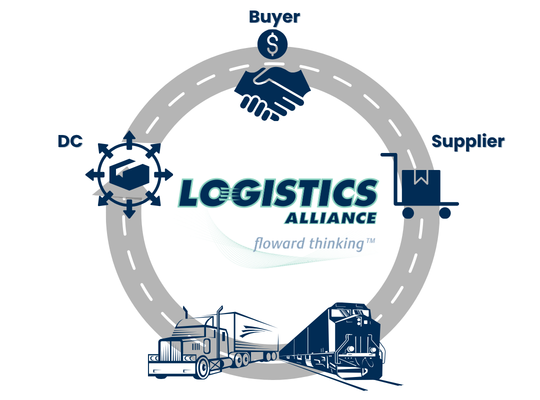
Suppliers, carriers, and retailers all play a role in how freight moves. Planning, execution, communication, and visibility must work together across each of these parties.
At Logistics Alliance, this is reflected in how we bring together operational teams and technology like Altruos to create shared visibility across stakeholders. The goal is not more data. It is making connected data useful, so teams can align earlier around what is happening, what it means, and what may require action.
When suppliers, carriers, and retailers are working from the same information, decisions become clearer, execution becomes more consistent, and on shelf availability improves.
Looking Forward
The next evolution of supply chain visibility is not about tracking shipments more closely.
It is about understanding what is happening early enough to influence the result.
For suppliers operating within complex retail networks, that shift from hindsight to foresight is becoming essential.
For retailers, that same shift supports more reliable inbound flow, improved coordination with suppliers and carriers, and ultimately stronger on shelf availability for consumers.
Because in modern logistics, success is not defined by explaining what went wrong. It is defined by preventing it altogether.