Why this document still matters in grocery and retail freight
In freight, the bill of lading is easy to treat like routine paperwork. In our experience at Logistics Alliance, that is one of the fastest ways to create avoidable problems.
A bill of lading is not just a shipping form. It is a core shipment document that functions as the shipment instructions, the carrier’s receipt, and key evidence of the contract of carriage. In Canada, bills of lading and contracts of carriage also carry legal weight in how responsibility, claims, and liability are assessed. That makes accuracy more than an administrative task. It makes it an execution and risk-control issue.
Why the bill of lading matters so much
In grocery and retail supply chains, the bill of lading sits at the intersection of shipping, receiving, compliance, and service.
From Logistics Alliance’s perspective, it is one of the simplest documents in the shipment lifecycle, but also one of the most important. When the bill of lading is right, it supports cleaner pickup execution, clearer receiving, stronger claim protection, and fewer downstream disputes. When it is incomplete or inaccurate, the impact can show up quickly in the form of delays, rejected freight, compliance issues, billing problems, and claim uncertainty.
That is especially true in retail environments where suppliers, carriers, retailers, and logistics partners all depend on the same shipment details being correct from the start.
What should be on the bill of lading
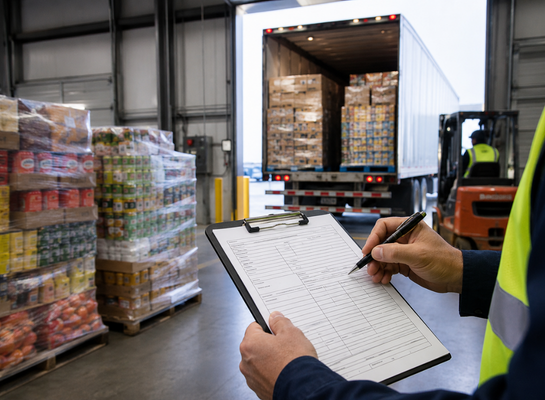
While requirements can vary by shipment and mode, the bill of lading should clearly identify the core shipment details needed for execution and legal clarity.
That typically includes:
- Shipper and consignee name and address
- Origin and destination
- Shipment date
- Carrier name
- Description of the goods
- Piece or pallet count
- Shipment weight
- Handling requirements
- Temperature instructions where applicable
- Declared value where applicable
- Special notes tied to delivery, appointments, or retailer requirements
Provincial freight rules in Canada require key shipment details to be documented, including consignor and consignee information, origin, date, carrier information, and a description of the goods including weight. Ontario’s freight rules also address declared value and notice-of-claim timing, while Manitoba’s rules similarly require core shipment details and signed changes if terms are altered.
What it means for each party
For suppliers and manufacturers
For suppliers, the bill of lading is the starting point for shipment accuracy. If the product description, weight, count, temperature requirement, or destination details are wrong, the risk does not stay on the page. It moves into the operation. In our experience, that can lead to receiving issues, retailer fines, claim disputes, and unnecessary back-and-forth.
For carriers and logistics providers
For carriers and logistics teams, the bill of lading is the operational baseline. It tells the team what was tendered, where it is going, and under what conditions it is expected to move. If that document does not match the freight, the work becomes harder to execute and harder to defend later if something goes wrong.
For retailers
For retailers and distribution networks, the bill of lading supports inbound readiness. Receiving teams need to know what is arriving, from whom, in what quantity, and under what handling requirements. In high-volume grocery and retail environments, clean document accuracy upstream supports better execution downstream.

Where technology is starting to matter more
This is also an area where technology is becoming more important.
Electronic bills of lading and digital freight-document workflows are gaining traction because they can reduce paperwork, improve data accuracy, speed up document flow, and support better visibility across the shipment lifecycle. Industry bodies and standards organizations are continuing to develop electronic bill of lading frameworks and data standards as digital trade and transport documentation evolves.
From a practical logistics perspective, the opportunity is not just to digitize a document. It is to make the information on that document cleaner, more structured, easier to validate, and more useful to the people executing the shipment. That is where document quality starts to become operational value.
The takeaway
At Logistics Alliance, we see the bill of lading as more than a required form. It is a control document.
For suppliers, it is a shipment-accuracy tool.
For carriers and logistics teams, it is an execution and accountability tool.
For retailers, it is part of inbound discipline and receiving efficiency.
A strong bill of lading will not solve every freight problem. A weak one, however, can create plenty.
Connect With Logistics Alliance
If you are reviewing your shipment documentation practices or looking for ways to improve execution across your grocery and retail freight, Logistics Alliance can help. Connect with our team to discuss how stronger shipment data and better transportation coordination can support your operation.